
ICONIC CAFÉ · PARIS · FOUNDED 1686
Café Procope: Where the French Revolution Was Brewed
The room where the Encyclopédie got planned, and where Benjamin Franklin came to gossip.
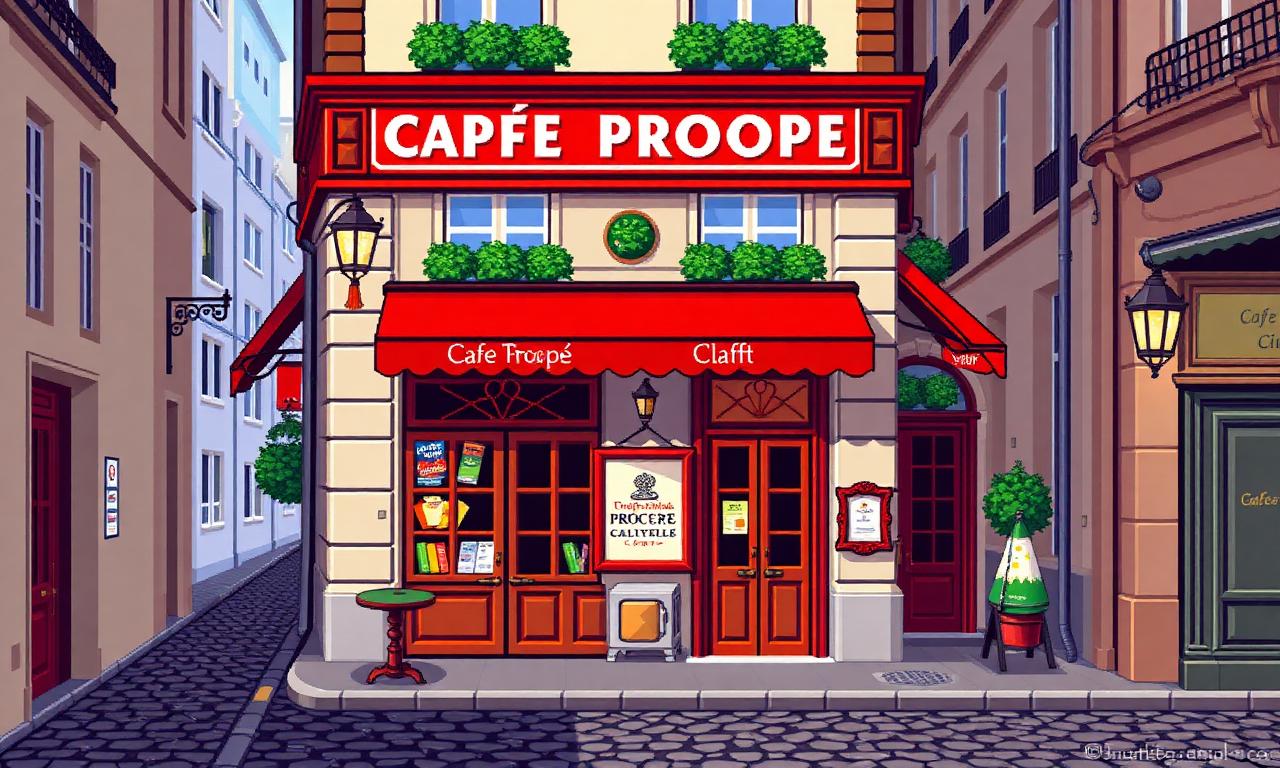
8-bit illustration · Coffee Craft
In 1686, a Sicilian named Francesco Procopio dei Coltelli opened a café on rue des Fossés-Saint-Germain in Paris, directly across from the Comédie-Française. He served coffee, sorbets, and chocolate in a mirrored, chandeliered room — a deliberate break from the smoky, male-only "cabaret" taverns of the era.[1] It worked. Café Procope is, by most counts, the oldest continuously operating café in Paris.
Why it mattered
Procope effectively invented the literary café as a European institution. By the mid-18th century its tables were the unofficial editorial office of the Encyclopédie: Denis Diderot and Jean d'Alembert met contributors there, and Voltaire was a daily customer who, legend insists, drank forty cups of coffee a day at its tables.[2] Rousseau, Montesquieu, and Benjamin Franklin all sat in the same small room.
A generation later, in 1789, the café became a hangout of the young revolutionaries — Danton, Marat, and Robespierre all argued politics over coffee at Procope before they argued it from the National Assembly.[3]
What you can still see
- Voltaire's marble table — preserved upstairs, with a stack of his books beside it.
- Napoleon Bonaparte's hat — left as collateral when, as a penniless young officer, he couldn't pay his bill.[4]
- Original 18th-century wood paneling and chandeliers — the room has been restored repeatedly but the bones are intact.
A unique fact to take with you
The reason cafés feel the way they do — small marble tables, mirrors on every wall, the implicit deal that one cup buys you hours — comes directly from Procope's original 1686 layout. Mirrors were chosen to make a small room feel grander and to multiply the candlelight; marble was chosen because it didn't absorb spilled coffee.[5] Every Parisian bistro, every Viennese coffeehouse, and arguably every modern third-wave café with subway tile and brass is a great-great-grandchild of that choice.
References
- Ellis, Markman. The Coffee House: A Cultural History. Weidenfeld & Nicolson, 2004.
- Pendergrast, Mark. Uncommon Grounds: The History of Coffee and How It Transformed Our World. Basic Books, revised ed. 2019.
- Schama, Simon. Citizens: A Chronicle of the French Revolution. Knopf, 1989.
- Café Procope official site. procope.com
- Cowan, Brian. The Social Life of Coffee: The Emergence of the British Coffeehouse. Yale, 2005.