
ICONIC CAFÉ · VIENNA · FOUNDED 1876
Café Central: Vienna's Marble Cathedral of Coffee and Talk
A room so important to public life that UNESCO listed the entire idea of a Viennese coffeehouse.
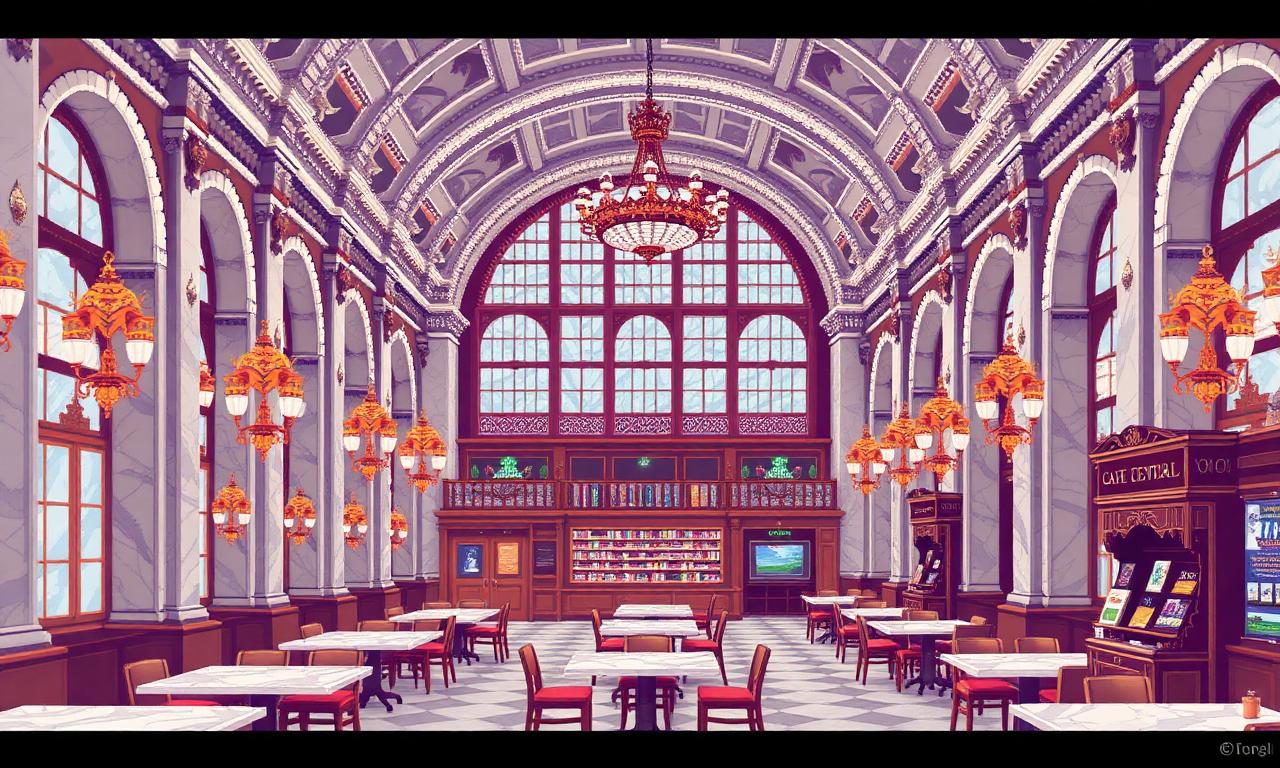
8-bit illustration · Coffee Craft
Café Central opened in 1876 on the ground floor of the Palais Ferstel in Vienna's first district — a vaulted neo-Gothic hall designed by Heinrich von Ferstel as the home of the Austro-Hungarian Bank.[1]Within a generation it had become the unofficial parliament, chess club, and reading room of late-Habsburg Vienna. The newspaper rack alone famously held more than 250 publications in a dozen languages.
Why it mattered
The Viennese coffeehouse was a third place before sociology had a word for it. The rules — implicit, ferocious — were these: order a single small coffee (a Wiener Melange, usually) with a glass of water; that buys you the table for as long as you want it; bring your own work; the waiter brings a fresh glass of water every twenty minutes whether you ask or not. Café Central was the most prestigious such room in the empire.
Regulars included Sigmund Freud, Stefan Zweig, Peter Altenberg (whose papier-mâché likeness still sits inside the door), Adolf Loos, and a young exile named Leon Trotsky, who played chess at the same table for years. The famous anecdote — when an Austrian official was warned in 1917 that revolution was coming to Russia he reportedly sneered, "And who will lead this revolution? Perhaps Mr. Bronstein from the Café Central?" — is almost certainly apocryphal, but it tells you exactly how the room was seen.[2]
What survived
- The vaulted ceiling, marble pillars, and original chess tables.
- The newspaper bar — still stocked with international press every morning.
- A house pastry chef who keeps the Central Torte (chocolate, marzipan, almond) in the daily rotation.
- The unwritten rule: one melange, one glass of water, one afternoon.
A unique fact to take with you
In 2011, UNESCO inscribed Viennese Coffeehouse Culture on its list of Intangible Cultural Heritage.[3]The citation describes the coffeehouse as "a place where time and space are consumed, but only the coffee is on the bill." Café Central is, in practice, the model the description is built on — which makes it possibly the only café in the world that is, legally, a UN-protected idea.
References
- Café Central, "Geschichte." cafecentral.wien
- Service, Robert. Trotsky: A Biography. Harvard University Press, 2009.
- UNESCO, "Viennese Coffee House Culture." ich.unesco.org
- Segel, Harold B. The Vienna Coffeehouse Wits, 1890–1938. Purdue University Press, 1993.