ICONIC CAFÉ · ROME · FOUNDED 1938
Caffè Sant'Eustachio: The Roman Bar With the Secret Espresso
One of the last cafés in Europe still roasting over wood fire. And the only one in Rome with a queue at 7 a.m.
8-bit illustration · Coffee Craft
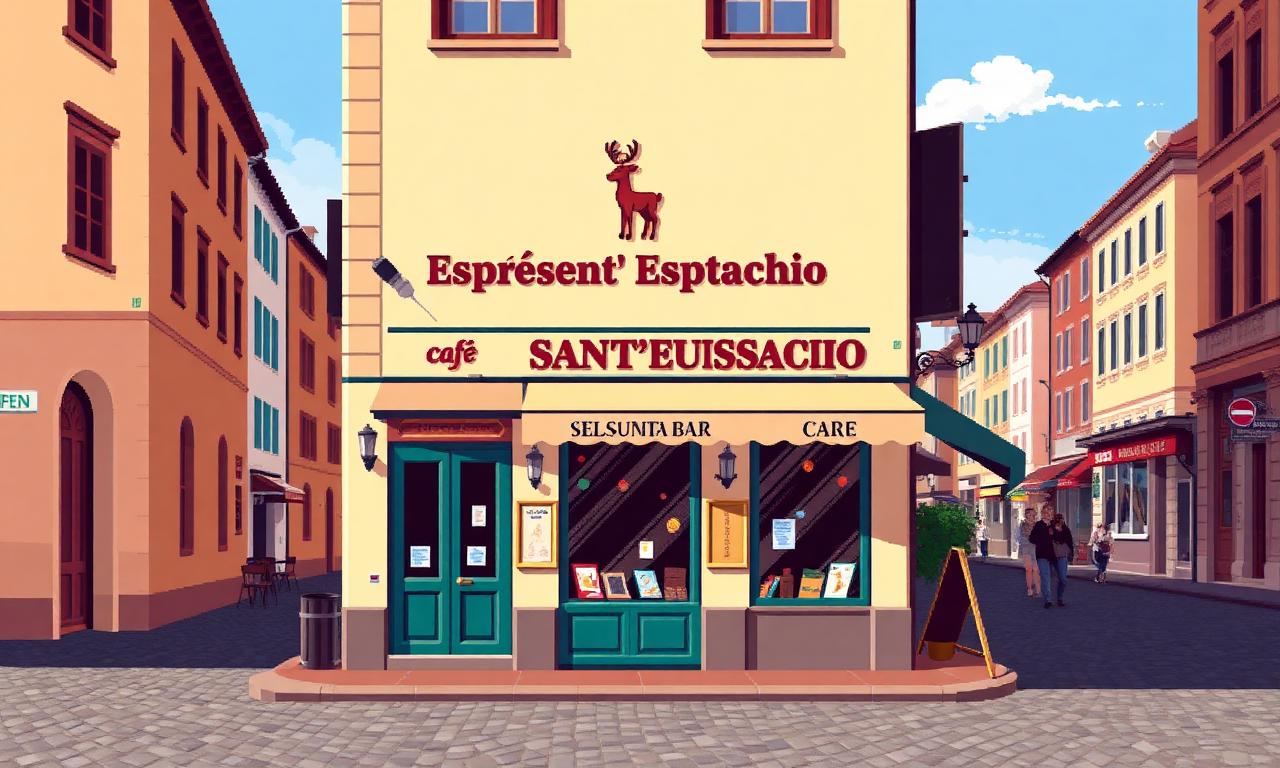
On a small square between the Pantheon and Piazza Navona, Caffè Sant'Eustachio Il Caffè has been pulling espresso since 1938.[1] The shopfront is unremarkable — a yellow facade, a small bronze deer on the sign — but the line at the bar moves continuously, all day.
Why it mattered
By the 1960s, Italian roasters had almost universally switched to gas and industrial drum roasters. Sant'Eustachio kept its wood-fired roaster, fueled with seasoned oak. They are now one of the last commercial roasters in Italy doing this at scale, and it is the single biggest reason their coffee tastes the way it does: dense, low-acid, smoky-sweet, slightly chocolatey.[2]
More famously, every espresso at the bar arrives capped with a thick, pillowy crema that other Roman bars have spent decades failing to reproduce. The bar refuses to explain the method. The baristas pull every shot behind a small metal shield so customers cannot see what is happening with the portafilter and the spoon.[3] Theories — a pre-stirred sugar trick, a specific tamping technique, a doctored portafilter — fly around Roman coffee circles, but the café has politely declined to confirm any of them for sixty years.
Two important Roman rules to know first
- You pay at the till, then take the receipt to the bar. Don't try to order at the counter first.
- Espresso comes pre-sweetened by default. If you don't want sugar you must explicitly order "senza zucchero, per favore." This catches almost every tourist exactly once.
What to order
- Gran Caffè — the house espresso, sweetened, with the legendary crema. The thing you came for.
- Monachella — espresso with a tiny "hood" of cold cream.
- Coffee beans — sold in branded tins, shipped worldwide, and the easiest way to recreate something resembling the bar's flavor at home.
A unique fact to take with you
The bronze deer on the sign is not a logo invention. The café is named after the nearby Basilica of Sant'Eustachio — the Roman general Saint Eustace, whose hagiography says he converted to Christianity after seeing a stag with a glowing crucifix between its antlers.[4] The same stag is on the roof of the basilica next door. So every espresso served in this bar, in some small way, traces back to a saint who is the patron of hunters, and was, very roughly, the original espresso early riser.
References
- Caffè Sant'Eustachio, "Storia." santeustachioilcaffe.com
- Morris, Jonathan. "The Cappuccino Conquests." Cultural and Social History, 2010.
- Hoffmann, James. The World Atlas of Coffee, 2nd ed. Mitchell Beazley, 2018.
- Lives of the Saints, "Saint Eustace." Butler's Lives, Burns & Oates.