BREW · ESPRESSO · 10 MIN READ
Espresso: Nine Bars of Pressure and a Hundred Years of Italy
A tiny cup of concentrated coffee that took a century of Italian engineering to perfect.
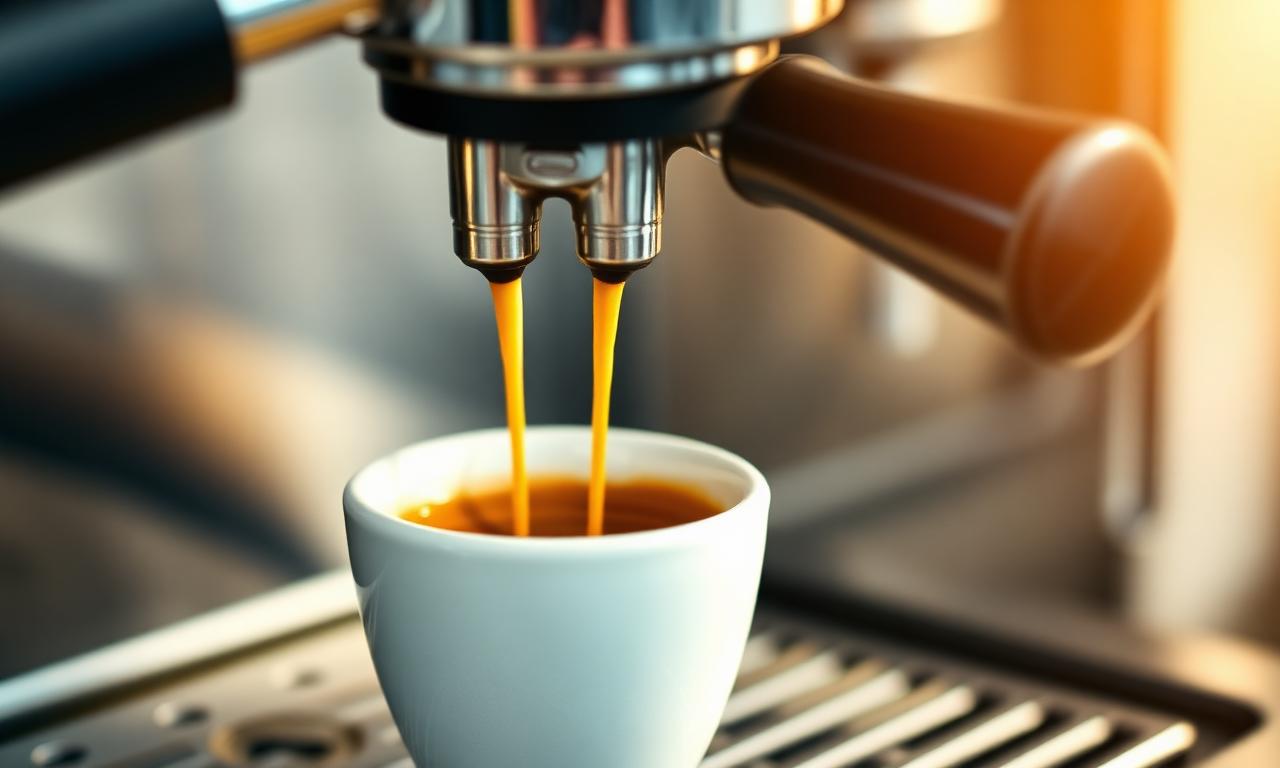
Espresso is the loudest, fastest, most opinionated way to make a cup of coffee. Hot water is forced — under roughly nine bars of pressure, about the same pressure you'd feel 90 meters underwater — through a tightly packed puck of finely ground coffee, in 25 to 30 seconds. What comes out is somewhere between a beverage and a sauce: a concentrated 30 ml shot, crowned with a foamy reddish-brown crema of emulsified oils and dissolved CO₂. Every milk drink you love — cappuccino, latte, flat white, cortado — starts with this shot.
A short, opinionated history
The word espresso just means "pressed out" (or, depending on whom you ask, "expressly for you"). The first patent for a pressure-driven coffee machine was filed by Angelo Moriondo in Turin in 1884for the Universal Exhibition — but his machine was a bulk brewer, not a per-cup device.[1] The leap to a single shot came in 1901, when Milanese engineer Luigi Bezzera patented a machine that brewed one cup at a time using steam pressure. Desiderio Pavoni bought his patent in 1903 and put espresso bars on every Italian corner.[2]
For the next forty years, espresso was steam-driven and topped out around 1.5–2 bars of pressure — closer to a Moka pot than a modern shot. The shot you know today was born in 1948, when Achille Gaggia (yes, that Gaggia) patented a lever-driven piston machine that hit roughly 9 barsof pressure. With it came the crema — that golden foam that confused customers so much when it first appeared that baristas had to put little signs on the bar: "È la crema naturale del caffè."[3]
The last big shift came in 1961, when Faema released the E61 — a machine that used an electric pump instead of a hand lever, and a clever heat-exchanger group head. Almost every commercial espresso machine since then descends from the E61.[4]
What "espresso" technically means
The Istituto Nazionale Espresso Italiano (the institute that certifies authentic Italian espresso) defines a single shot as:
7 g (±0.5) of coffee · 25 ml (±2.5) in the cup · 25 s (±5) extraction · water at 88 °C (±2) · 9 bar (±1) of pressure.[5]
That's the traditional Italian definition. Modern specialty espresso — the kind a third-wave café pulls — tends to use 18–22 g of coffee in a double basket, pulling 36–45 g in the cup over 25–32 seconds. The ratios are bigger and the result is brighter, more nuanced, less roasty. Both are "espresso." They're just different dialects.
The variables you actually control
Espresso is the brewing method with the smallest margin for error. A small change anywhere ripples through everything:
- Grind size: the most powerful lever. Finer = slower flow, more extraction. Coarser = faster flow, less extraction.
- Dose: the weight of dry coffee. More dose = more resistance, longer shot.
- Yield: what comes out the spouts. Ratio of yield to dose ("brew ratio") is the dial.
- Time: the consequence of the above. Useful diagnostic, not a target.
- Temperature: 90–94 °C is the common range. Lighter roasts like it hotter.
A home recipe that actually works
For a modern double shot with a typical medium-roast bean:
- Dose: 18 g coffee in a 18 g VST basket.
- Yield: 36 g espresso in the cup (1:2 ratio).
- Time: 27–32 seconds from pump-on.
- Temperature: 93 °C.
- Pressure: 9 bar.
If the shot runs long (over 35 s) and tastes hollow or bitter, grind coarser. If it gushes out in under 20 s and tastes sour and thin, grind finer. Make one change at a time. Espresso punishes people who change two variables at once.
What crema actually is (and what it isn't)
Crema is a foam of emulsified coffee oils, dissolved CO₂ that's coming out of solution as the shot enters the cup, and finely dispersed solids. It is not a sign of quality on its own — a very dark roast and an old, gummy Robusta can both produce thick crema that tastes terrible. A good shot has thick, reddish-brown, hazelnut-colored crema with a "tiger striping" of darker streaks. But the real test is the cup, not the foam.
A unique fact to take with you
The reason a proper espresso comes in a tiny pre-warmed ceramic cup is partly thermal physics. A cold cup steals heat from the shot in the first three seconds — enough to drop the drinking temperature by 5–10 °C and dull the high-frequency aromatics that volatilize above 60 °C. Italian bars warm cups on top of the machine for a reason; the cup is part of the recipe.[6]
References
- Morris, Jonathan. Coffee: A Global History. Reaktion Books, 2019, p. 75–78.
- Bezzera, Luigi. "Apparatus for the preparation of coffee beverage," Italian patent No. 61707 (1901).
- "The History of Crema." Gaggia Milano archives. gaggia.com
- "The Faema E61 — A Machine That Changed Espresso." Perfect Daily Grind, 2019. perfectdailygrind.com
- "Certified Italian Espresso." Istituto Nazionale Espresso Italiano. espressoitaliano.org
- Illy, Andrea & Viani, Rinantonio (eds.). Espresso Coffee: The Science of Quality. Academic Press, 2nd ed., 2005.
- Barista Hustle. "Espresso Recipes and Brew Ratios." baristahustle.com