BREW · FRENCH PRESS · 8 MIN READ
French Press: The Honest Brewer Everyone Underrates
The simplest device in your kitchen makes some of the most interesting coffee you'll drink — if you treat it right.
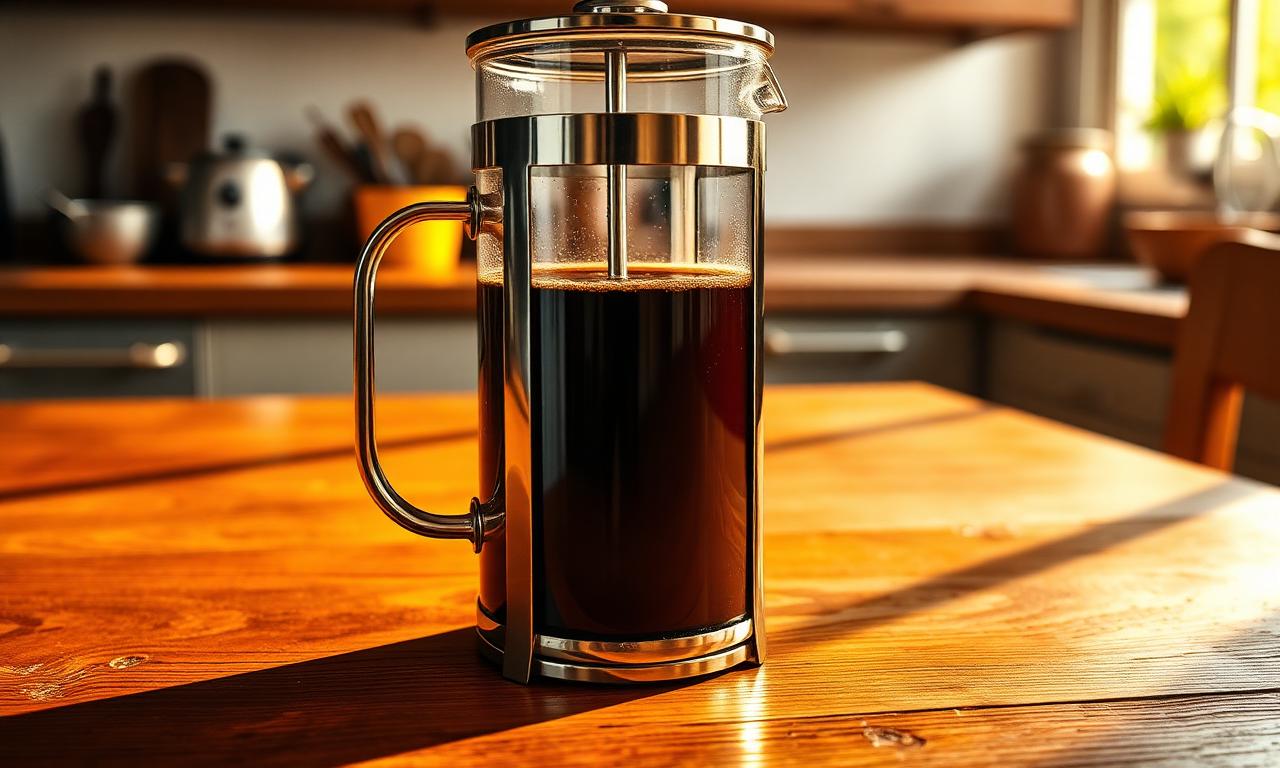
The French press is the underrated middle child of the coffee world. It's cheap, indestructible, requires no paper filters, and produces a cup that's heavier and more textured than anything that comes out of a paper-filter brewer. If you've only ever had a bitter, gritty French press cup at someone's parents' house, this is the article that fixes it.
It isn't actually French (probably)
The earliest known patent for what we'd recognize as a French press was filed in 1929 by an Italian designer named Attilio Calimani in Milan.[1]The Danish company Bodum popularized the design globally in the 1950s and 60s under the name Chambord, which is why most people think of it as Scandinavian.[2] The "French" in the name comes from an earlier, much rougher version that French peasants apparently used in the 1850s: a piece of cloth on a stick, pushed through a pot of brewed coffee.
What immersion brewing actually does
A French press is an immersion brewer. The coffee grounds sit in the water for the entire brew, instead of having water pass through them like a pour-over. Two consequences:
- Extraction is more uniform. Every ground particle is bathed in water for the same length of time. There are no fast-flow channels or paper bypass.
- The metal mesh keeps oils and fines in the cup. Paper filters trap the natural oily compounds in coffee called diterpenes (cafestol and kahweol). The mesh in a French press lets them through, which is why French press tastes rounder and richer — and, incidentally, why some studies have linked unfiltered coffee to slightly higher LDL cholesterol when drunk in large quantities.[3]
The Hoffmann technique (a cleaner press cup)
The classic complaint about French press is sediment — that gritty sludge at the bottom of the cup. James Hoffmann published a method in 2017 that uses physics instead of force to fix it. It's now the standard.[4]
- Coffee: 30 g, ground coarse (sea salt).
- Water: 500 g at 92 °C.
- Ratio: 1:16.6.
- 0:00 — Pour all 500 g of water onto the grounds. Don't stir yet.
- 4:00 — Break the floating crust with a spoon, stirring gently three or four times. Most of the grounds will sink.
- 4:30 — Scoop the remaining foam and floating grounds off the top with two spoons. (This is the secret step.)
- 4:30–9:00 — Leave it alone. Let the remaining fines settle to the bottom on their own.
- 9:00 — Place the plunger gently on top, just to keep the surface in place. Pour slowly. Stop before the last 50 ml — that's the sludge.
The first time you do this, you'll be surprised how clean the cup tastes. Almost like a really heavy pour-over.
Common mistakes
- Grinding too fine. Most home grinders set to "French press" still produce too much fines. Go coarser than you think. If your grinder has burrs, this matters less.
- Slamming the plunger down. This forces fines through the mesh into your cup. Press slowly, or don't press at all.
- Leaving brewed coffee in the press. The grounds keep extracting. By the time you pour your second cup, it's bitter. Decant.
- Using stale, oily dark-roast pellets. The press will faithfully transmit every defect. Try a fresh medium roast and see what changes.
A unique fact to take with you
The French press might be the brewing method with the highest ratio of flavor complexity to equipment cost in coffee. A 35 USD borosilicate Bodum, treated correctly, produces a cup that highlights body, sweetness, and texture in a way that a 3,000 USD espresso machine cannot reproduce. It's the brewer professional cuppers use when they want to evaluate a coffee honestly — most cupping protocols are essentially small French presses without the plunger.[5]
References
- Calimani, Attilio. "Filtro per the e caffè," Italian patent No. 263177 (1929).
- "Our History — Chambord French Press." Bodum. bodum.com
- Urgert, R. & Katan, M.B. "The cholesterol-raising factor from coffee beans." Journal of the Royal Society of Medicine, 1996; 89(11): 618–623. PubMed Central
- Hoffmann, James. "The Ultimate French Press Technique." (2017). YouTube
- "SCA Cupping Protocols." Specialty Coffee Association. sca.coffee
- Hoffmann, James. The World Atlas of Coffee, 2nd ed. Mitchell Beazley, 2018, p. 105–110.