BREW · POUR-OVER · 9 MIN READ
Pour-Over Coffee: The Quiet Science of a Slow Kettle
Hot water meets ground coffee meets gravity. Everything else is detail.
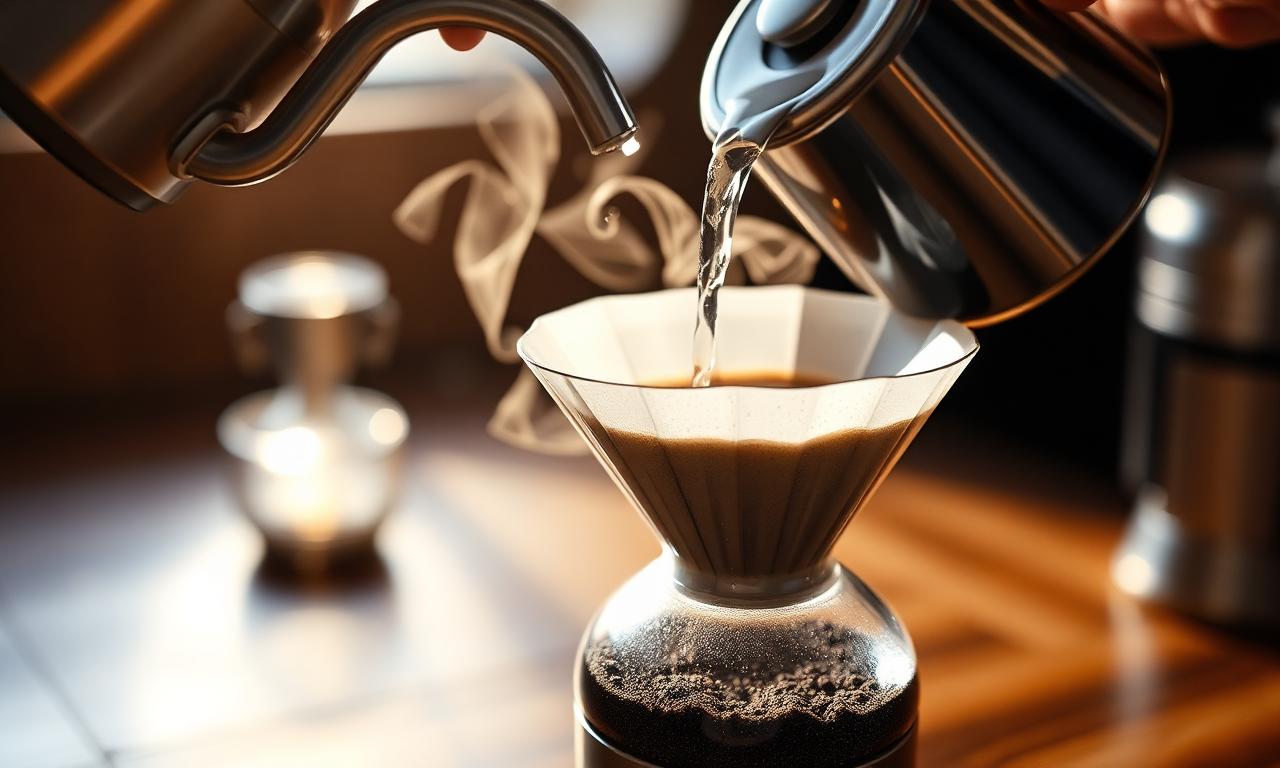
Pour-over is the brewing method that taught a generation of coffee drinkers to slow down. The whole thing is just hot water, ground coffee, a paper filter, and gravity — and yet there's a sub-culture of people who'll argue about the spiral of their pour the way wine people argue about glassware. The good news: 90% of the result comes from a small handful of variables, and once you understand them, the cup is genuinely yours.
A short history of dripping water through coffee
Filter coffee as we know it was invented in 1908 by a German housewife named Melitta Bentz, who got tired of grounds in her teeth and punched holes in a brass pot, lining it with a sheet torn from her son's school notebook. Her patent (Imperial Patent Office, June 20, 1908) is the moment paper filtration becomes a thing.[1] Her company still sells filters today.
The modern specialty pour-over story really starts much later, in Tokyo. Hario released the conical V60 dripper in 2004 — sixty degrees, a single big hole, deep internal ribs to keep the paper from suctioning flat. It took a decade to spread, but it's now the most-imitated brewing device on Earth.[2] The other classic, the Chemex, was designed in 1941 by a German chemist named Peter Schlumbohm, who borrowed the shape from a laboratory Erlenmeyer flask and the handle from a sleeve of wood and leather. It's in the permanent collection of MoMA.[3]
What's actually happening in the cone
When hot water hits coffee, three things happen in roughly this order:
- Wetting and degassing. Trapped CO₂ rushes out (the "bloom"). Fresh coffee bloats; stale coffee doesn't.
- Dissolution. Water dissolves soluble compounds from the grounds — first the bright acids and aromatics, then the sweet sugars, finally the bitter, heavier compounds.
- Drainage. Gravity pulls the solution through the bed and the filter into the carafe. The paper holds back oils and fine sediment, which is why pour-over tastes clean.
The Specialty Coffee Association formalized the target for this extraction decades ago: a brew is in the "ideal" zone when you extract roughly 18–22% of the bean's soluble mass, ending up at a beverage strength of about 1.15–1.45% total dissolved solids.[4] Under-extract and it tastes sour and salty. Over-extract and it tastes hollow and bitter. Your job, with a kettle in your hand, is to land in the middle.
A recipe that just works (Hoffmann-style V60)
This is a slight adaptation of James Hoffmann's widely shared "best one-cup V60" technique.[5] It's a forgiving starting point.
- Coffee: 15 g, ground medium-fine (like table salt).
- Water: 250 g, 92–96 °C (just off the boil).
- Ratio: 1:16.6.
- Filter: Rinse with hot water first — this kills the papery taste and warms the dripper.
- Total time: 3:00–3:30.
- 0:00 — Pour 45 g of water in slow circles. Let it bloom for 45 seconds. (Optional: gently swirl the dripper to wet all grounds.)
- 0:45 — Over 30 seconds, pour to 150 g total, in circles, staying off the paper.
- 1:15 — Over 30 more seconds, pour to 250 g.
- 1:45–3:00 — Let it draw down. Give the dripper one final gentle swirl at the end to flatten the bed.
The five variables, ranked by impact
- Grind size. The single most powerful lever. Finer = more extraction. Coarser = less.
- Ratio. 1:15 is strong and intense; 1:17 is delicate and tea-like. Most people land between.
- Water temperature. Lower (88–92 °C) for darker roasts; higher (94–96 °C) for light roasts. Hotter water extracts faster.
- Time. Longer drawdowns = more extraction. If yours is sailing past 4 minutes, grind coarser.
- Water itself. Coffee is 98.5% water. Hard, mineral-rich water dulls a cup; super-soft water makes it flat. The SCA's recommended profile is around 150 ppm total hardness with low alkalinity.[6]
Common mistakes I see every week
- Not rinsing the filter. You'll taste the paper. It's subtle but it's there.
- Pouring on the walls. Water that bypasses the bed of grounds is wasted; it dilutes without extracting.
- Using stale coffee. No technique fixes coffee roasted three months ago. Look at the bloom — flat bloom, flat cup.
- Eyeballing doses. A cheap kitchen scale that reads to 0.1 g is the single best upgrade most home brewers can make.
A unique fact to take with you
The V60's signature shape isn't an aesthetic choice. The 60° cone angle exists because at exactly that geometry, the depth of the coffee bed stays consistent regardless of dose — meaning the same recipe scales smoothly from 15 g up to 40 g without re-tuning the grind much. The spiral ribs aren't decoration either; they create vertical air channels so the paper doesn't suction shut and choke the drawdown.[2]
References
- "Melitta Bentz — The Inventor of the Coffee Filter." Melitta Group. melitta-group.com
- "V60 Dripper — Design Philosophy." Hario Co., Ltd. global.hario.com
- "Coffeemaker (Chemex), 1941." Museum of Modern Art collection. moma.org
- "Coffee Brewing Control Chart." Specialty Coffee Association. sca.coffee
- Hoffmann, James. "The Ultimate V60 Technique." (2019). YouTube
- "SCA Water Quality Standard." Specialty Coffee Association, 2018. sca.coffee
- Hoffmann, James. The World Atlas of Coffee, 2nd ed. Mitchell Beazley, 2018.