SPECIES · 9 MIN READ
The Four Coffees: Arabica, Robusta, Liberica & Excelsa
Four species, one cup. A friendly tour of who grows where and why it matters.
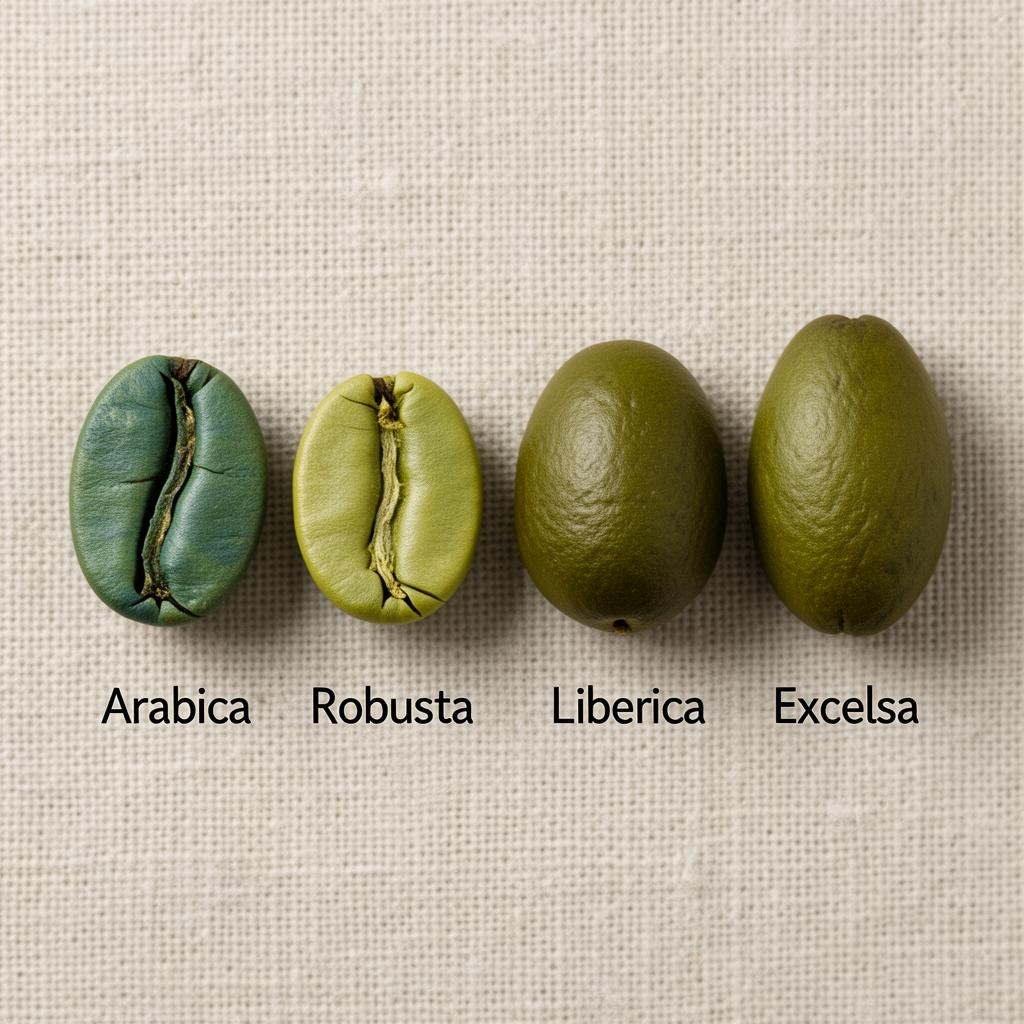
Pull up a stool. Most of what you've ever drunk — every espresso, every drip cone, every desperate gas-station refill — comes from just two coffee species: Arabica and Robusta. There are technically over a hundred wild Coffea species, but humans only ever bothered to farm a handful of them, and only four show up on a bag at any scale. Let me walk you through them the way I'd walk a friend through the menu on their first day in a specialty café.
Arabica — the one you almost certainly drink
If a bag says "100% Arabica," it isn't bragging about a rare grape. It's telling you something simple: this is the species we associate with flavor. Arabica (Coffea arabica) is sweeter, more aromatic, more acidic in the bright, fruity sense of the word, and a great deal more fragile than its cousins. It likes elevation — usually 1,200 to 2,200 meters above sea level — cool nights, gentle rain, and consistent shade. Push it down a mountain into the heat and it sulks; the cherries ripen unevenly and the cup goes flat.
Arabica is what specialty coffee was built on. Ethiopia is its ancestral home — the species probably crossed itself into existence in the highlands somewhere south of Addis, a few hundred thousand years ago. From there it walked, slowly and mostly by accident, into Yemen, then onto Dutch and French ships, then onto every mountain in the tropics that could support it. Today it's roughly 60% of the global crop and almost 100%of what gets called specialty.

A trick for the visual learners: an Arabica bean is long and oval, and the crease down its middle is curved, like an S. Hold one up to the light next to a Robusta and you'll never forget.
The catch — and there is always a catch — is that Arabica is beautifully bad at defending itself. It's vulnerable to leaf rust, to berry borer, to a warming planet that keeps nudging the cool zones higher up the mountain than the mountains actually go. A farmer in Honduras or Ethiopia today is having a much harder conversation with this plant than her grandfather did.
Robusta — the tough one with a bad reputation
Coffea canephora, called Robusta because it is, has spent the last fifty years as the villain of specialty coffee. It grows at low elevations, in heat that would kill Arabica, on plants that laugh off pests. It yields more cherries per tree. It contains roughly twice the caffeine — which is one of the reasons the plant survives so well; caffeine is a natural insecticide.
For a long time, Robusta in your cup meant "cheap and harsh." The classic descriptors are rubbery, woody, burnt-tire, ashy. That reputation came from a real place: most Robusta was grown for volume, processed sloppily, and roasted into oblivion to mask the defects. If your worst-ever coffee was a 7-Eleven dark roast in 2003, you were probably drinking poorly handled Robusta.

But Robusta is having a small renaissance. A handful of farmers in India, Uganda, and Brazil are treating it like a fine product — picking only ripe cherries, fermenting carefully, roasting it light. The result is something you'd never call elegant, but it's clean: dark chocolate, peanut, dried tobacco, sometimes a wild fermented sweetness. It's also what gives a good Italian espresso blend its thick crema and that satisfying chest-thump of body. A serious bar in Rome is almost certainly hiding 10–30% Robusta in the hopper. Don't tell anyone.
Visually: a Robusta bean is small, round, and the crease down the middle is straight. It looks, frankly, a little stubborn.
Liberica — the weird one you should try once
Now it gets interesting. Coffea liberica is the third species, and for most of the twentieth century almost nobody was paying attention to it. It accounts for somewhere around 1–2% of world production. It grows mostly in the Philippines, Malaysia, parts of West Africa where it's native, and increasingly in Borneo, where small producers are doing strange and beautiful things with it.
Pick up a Liberica bean and the first thing you notice is that it's huge and lopsided — twice the size of Arabica, asymmetric, almost teardrop-shaped. The tree itself is enormous, sometimes twenty meters tall, with leaves the size of dinner plates. It's also stubborn in its own way: it cross-pollinates unwillingly, fruits irregularly, and resists most attempts at mechanization.
Liberica tastes like coffee that's been reading a different book. Smoky, woody, a little funky — sometimes jackfruit, sometimes dark honey, sometimes a touch of something almost meaty.
It is not the coffee for someone who wants a familiar morning cup. It is the coffee for someone who's been drinking specialty for three years and is bored. If your roaster ever lists a Liberica on the menu, buy 100g, brew it as a V60, and pay attention.
Excelsa — Liberica's flirty cousin
For decades, botanists argued about whether Excelsa was its own species or a subspecies of Liberica. In 2006 they settled it — officially, it's Coffea liberica var. dewevrei. To the people who roast it, it doesn't really matter. Excelsa tastes different enough from anything else that it gets its own slot on the menu.
It's grown mostly in Southeast Asia — Vietnam, Laos, Cambodia, northern Thailand — and Central Africa. Cup profile: tart, fruity, sometimes shockingly sour in the way a green plum is sour. A good Excelsa has flavors of stewed dark fruit, a hint of tamarind, and a finish that reminds people of red wine. Blenders love it for adding lift and complexity to a base of Arabica or Robusta — a kind of seasoning bean.
So what should you actually buy?
For everyday drinking, Arabica. It's where the entire conversation of specialty coffee is happening, and the rabbit hole goes very, very deep. For espresso with weight and crema, find a blend that's honest about including a small percentage of high-quality Robusta — it'll cost less and probably taste better than the all-Arabica blend next to it on the shelf. And once a year or so, buy a small bag of Liberica or Excelsa from a roaster you trust, brew it slowly, and let yourself be surprised. Coffee is a much bigger country than the part of it we usually visit.
Next time you pick up a bag, flip it over and look for the species. If it just says "coffee," it's Arabica. If it says "Robusta," the roaster is telling you something deliberate. If it says "Liberica" or "Excelsa," they're inviting you somewhere.
Go on. The water's still hot.
References
- Davis, A. P. et al. "An annotated taxonomic conspectus of the genus Coffea." Botanical Journal of the Linnean Society, 2006; 152(4): 465–512. Royal Botanic Gardens, Kew
- "Coffee Production and Trade — Annual Statistics." International Coffee Organization. ico.org
- Hoffmann, James. The World Atlas of Coffee, 2nd ed. Mitchell Beazley, 2018.
- "Coffea liberica — Botanical Profile." Royal Botanic Gardens, Kew. Plants of the World Online
- Davis, A. P. & Rakotonasolo, F. "A taxonomic revision of the baracoffea alliance: nine remarkable Coffea species from western Madagascar." Botanical Journal of the Linnean Society, 2008; 158(3): 355–390.
- "Robusta Renaissance: Why High-Quality Robusta Matters." Perfect Daily Grind, 2022. perfectdailygrind.com