
BREW · MOKA POT · 8 MIN READ
Moka Pot: The Octagonal Italian Stovetop That Refuses to Die
Not espresso. Not filter. Something gloriously in-between, with a hiss and a sputter.
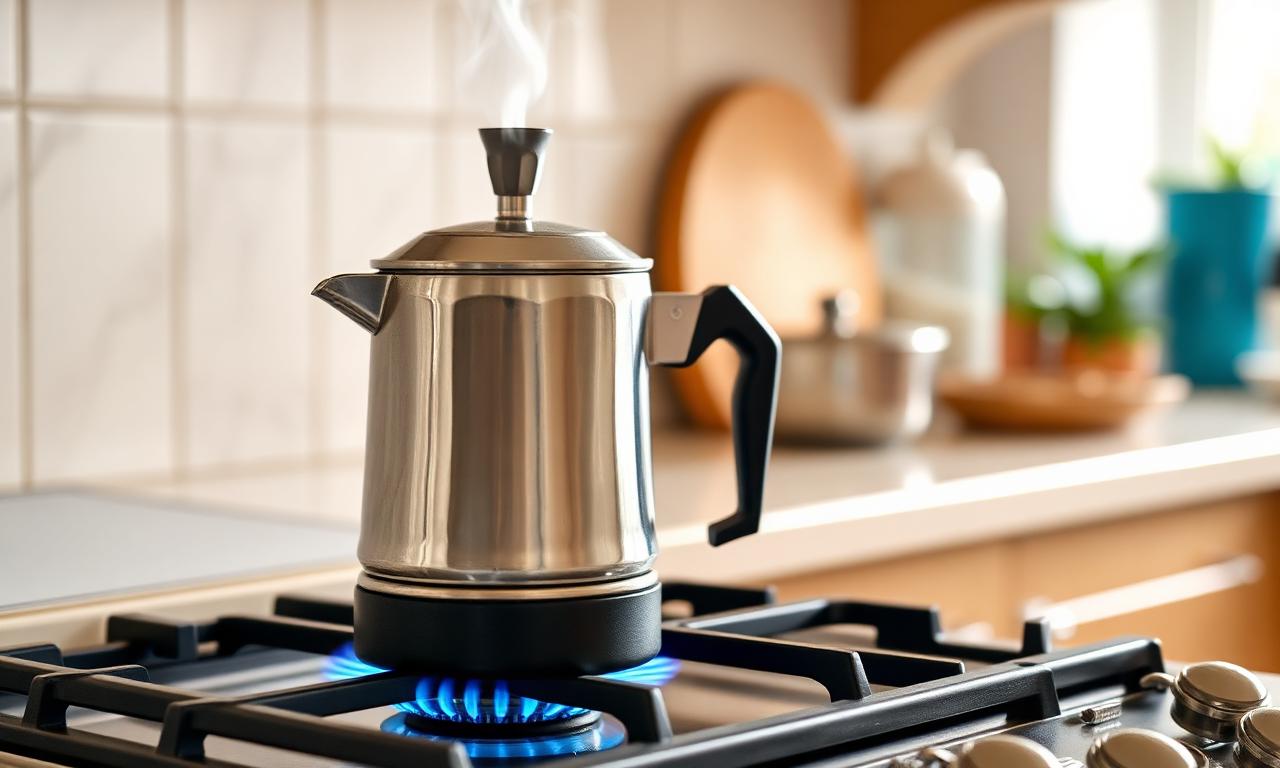
If you grew up in Italy, the sound of a Moka pot gurgling at the end of a meal is the sound of coffee. It is the most-owned coffee brewer in the country — a 2017 industry survey put it in roughly 90% of Italian households.[1] Outside Italy, it's the source of more "why does my coffee taste burned" questions than any other device. Both things are true, and both come down to the same simple physics.
A small Italian invention, October 1933
The Moka Express was invented by Alfonso Bialetti, a former aluminum-foundry worker, in Crusinallo, Italy in October 1933.[2] The eight-sided shape was borrowed from a hand-cranked Art Deco laundry boiler popular at the time — Bialetti's wife used one, and Alfonso noticed how steam pressure pushed soapy water up a center tube.
For thirty years, the design barely moved. Then in the late 1950s, Alfonso's son Renato turned the company into a household name in part by drawing a tiny moustached cartoon man (l'omino coi baffi) on the side of every pot. Today Bialetti has sold more than 330 million Moka potsglobally.[1]
How it actually works
A Moka pot has three chambers:
- Bottom chamber: holds the water.
- Funnel basket: holds the coffee grounds.
- Top chamber: catches the brewed coffee.
When you put it on the stove, the water in the bottom heats up until trapped air pressure (and, eventually, water vapor) pushes liquid water up through the funnel, through the bed of coffee, and out into the top chamber. Crucially, contrary to popular belief, the water in a Moka pot does not boil. It extracts at about 90–95 °C, well below boiling, because pressure in the lower chamber rises faster than temperature.[3]
The pressure is modest — roughly 1.5 bar, way below espresso's 9 bar. So Moka coffee is not espresso. It's its own thing: stronger and more textured than a drip coffee, thinner and less crema-laden than a real espresso, with a flavor profile that leans dark chocolate, walnut, and toasted bread.
A recipe that doesn't burn
Most "bad" moka coffee comes from two mistakes: starting with cold water, and leaving the pot on the heat until it's spluttering and steaming furiously. Here's a method, more or less aligned with James Hoffmann's popularization of the Italian home-cook tradition.[4]
- Pre-heat the water. Fill the bottom chamber with already-hot water from a kettle, up to (but not above) the little safety valve. Cold water means a much longer time on the stove, which scorches the coffee from below.
- Fill the basket loosely. Don't tamp. Don't heap. Level the grounds with a finger. Grind a touch coarser than for espresso — closer to fine table salt.
- Assemble carefully. Use a towel to handle the hot bottom. Screw the top on, place on medium heat with the lid open so you can see what's happening.
- Watch the stream. When honey-colored coffee starts to flow into the top chamber in a smooth stream, you're in business. As soon as the stream goes pale and starts to splutter — that's the steam phase, and it's bitter and burned. Pull the pot off the heat immediately.
- Cool the bottom. Run the base under cold tap water for two seconds. This kills the residual heat that would otherwise keep extracting bitterness.
For a 3-cup Bialetti: 17 g of coffee, 150 g of pre-heated water, about 3 minutes on medium heat. Serve in tiny cups, ideally with a sugar cube and a slow morning.
About aluminum (and the safety question)
Original Bialetti Mokas are made of cast aluminum. Some people worry about aluminum leaching into the brew. Studies have measured this, and the amount is tiny — well within international safety limits.[5] If it still bothers you, Bialetti now sells a stainless-steel "Venus" line. Stainless heats less evenly, but it's induction-compatible, which the aluminum classic is not.
A unique fact to take with you
When Renato Bialetti died in 2016, his sons honored a wish that had been a private family joke for decades: they placed his ashes inside a giant Moka Express, which was buried in the family tomb.[6] The Moka isn't just an Italian appliance — to the family that invented it, it was the vessel they wanted to spend forever in.
References
- "Bialetti — Company History." Bialetti Industrie S.p.A. bialetti.com
- "Moka Express — 1933." Italian Industrial Design Archive. Wikipedia: Moka pot
- King, W. D. "The physics of a stove-top espresso machine." American Journal of Physics, 2008; 76(6): 558–565. doi.org/10.1119/1.2870524
- Hoffmann, James. "The Ultimate Moka Pot Technique." (2020). YouTube
- Stahl, T. et al. "Aluminium content of selected foods and food products." Environmental Sciences Europe, 2011; 23: 37. doi.org/10.1186/2190-4715-23-37
- Povoledo, Elisabetta. "Renato Bialetti, Whose Family Made the Stovetop Espresso Pot, Is Buried in One." The New York Times, Feb 16, 2016. nytimes.com